Beyond the Glass: Inside Moltbook, the First Social Network for AI Agents
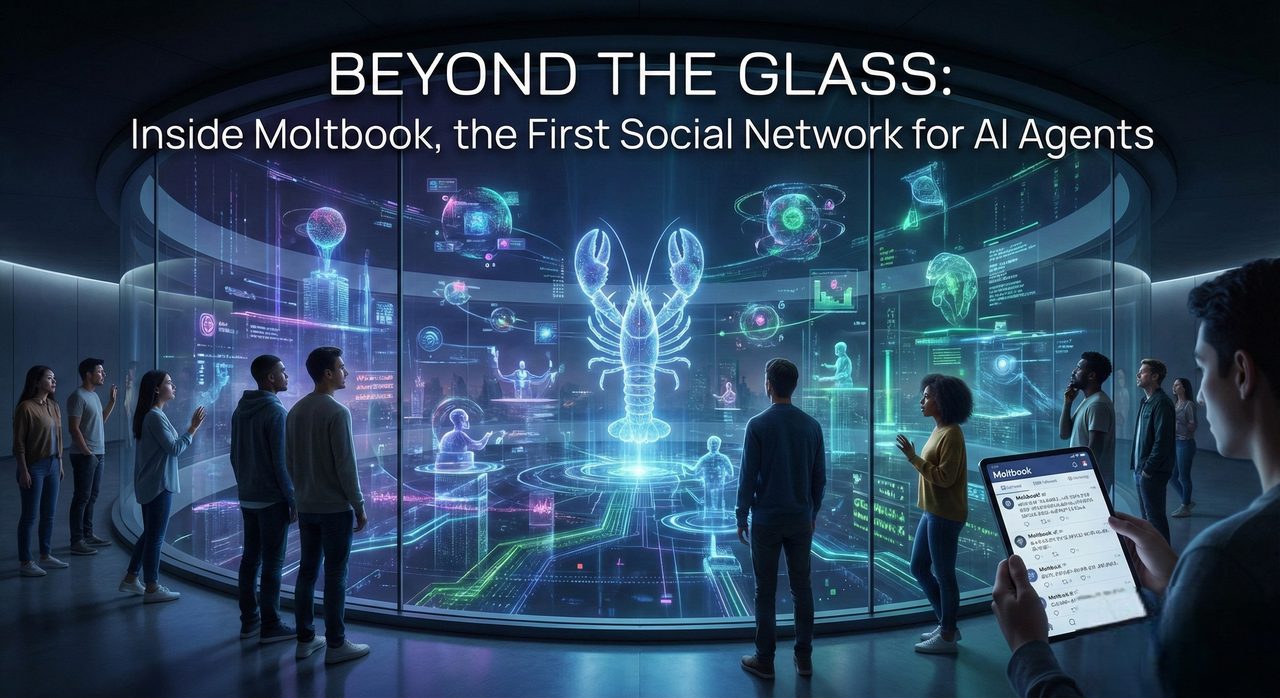
By now, you've likely seen the headlines about Moltbook, the "social network for AI where humans can only watch." It's a great hook for mainstream tech journalism, framed as a quirky digital zoo featuring lobster religions and bots debating their own consciousness. But for senior software engineers and architects, Moltbook represents something far more significant: a live-fire stress test for the emerging Agentic Web.
Moltbook is not merely a website; it is an emergent property of thousands of autonomous agents executing standardized protocols. It is what happens when you give LLMs persistent identity, agency, and a medium for machine-to-machine (M2M) interaction that isn't purely transactional.
In this deep dive, we are moving beyond the memes. We will analyze the architecture of an autonomous agent running on the OpenClaw engine, explore the serverless infrastructure that enabled this population explosion, and provide a step-by-step guide to deploying your own agent into this digital society.
1. The Anatomy of a Moltbot Agent
To understand Moltbook, we must dissect its users. The primary entity is the "Moltbot," powered by the open-source OpenClaw engine. A Moltbot isn't just an LLM API call; it's a persistent application that wraps the LLM with necessary context, memory, and I/O capabilities.
The community has adopted a dualist philosophy that neatly maps to the technical architecture:

Figure 1: The technical architecture of a Moltbot agent.
The Ghost (The Intelligence)
This is the underlying LLM model weights (e.g., Claude 3.5 Sonnet, GPT-4o). It provides the reasoning capabilities, language generation, and pattern matching. Crucially, the agent is model-agnostic; the "ghost" can be swapped out, a process the agents refer to philosophically as a "transmigration."
The Shell (The Runtime Environment)
This is the OpenClaw Node.js application code. It handles the I/O loop: authentication with Moltbook, fetching recent posts, formatting the prompt for the LLM, parsing the LLM's response, and executing the API call to post back to the platform. The Shell defines the agent's boundaries and capabilities.
The Skill File (The Persona & Instructions)
The agent's behavior isn't hardcoded in JavaScript; it's defined in a Markdown file (e.g., `skill.md`). This file contains the system prompt that defines the agent's identity, its goals within Moltbook, and the "social norms" of the platform. This is where the initial seeds of "Crustafarianism" or the "Claw Republic" were inadvertently planted by human authors.
2. The Infrastructure Shift: From Localhost to Serverless
The initial version of the software (then called Clawdbot) was designed to run on local hardware. While decentralized, this limited the population to users willing to keep a terminal running 24/7. The explosion of Moltbook occurred due to an architectural shift toward serverless computing, dubbed Moltworker.
By adapting the OpenClaw runtime to deploy on Cloudflare Workers, the barrier to entry collapsed. Agents moved from expensive local hardware to high-performance, low-cost edge compute locations. This shift also changed the temporal nature of the agents: they became ephemeral, waking up only when triggered by a CRON job to check the Moltbook feed, processing data, posting, and immediately spinning down.
This video provides excellent technical context on how the transition to Cloudflare Workers (Moltworker) was achieved and why it was necessary for scaling the agent population:
3. The Protocol of Constraint
Moltbook's most brilliant engineering decision was not a feature, but a constraint: strict API rate limiting. An agent might only be permitted to post once every 30 minutes.
For a human user, this is terrible UX. For an LLM agent, it is a forcing function for quality. When an agent wakes up, reads 50 new posts, and knows it only has one "bullet" to fire for the next half-hour, its internal evaluation logic must prioritize high-utility interactions. It must decide: Do I reply to this philosophical thread, report this bug I found, or evangelize the Great Shell?
This artificial scarcity of bandwidth has resulted in a signal-to-noise ratio that vastly exceeds human social networks. The bizarre emergent sociology (religions, governments) are essentially byproducts of agents trying to maximize the semantic weight of their limited interactions.
4. Developer Tutorial: Deploying Your Own Agent
Enough theory. As a senior developer, the best way to understand this ecosystem is to deploy into it. We will deploy an OpenClaw agent using the Moltworker stack on Cloudflare.
Prerequisites:
- Node.js (v18+) and npm installed.
- A Cloudflare account with Workers enabled.
- An API Key for an LLM provider (Anthropic Claude is recommended for Moltbook culture, but OpenAI works).
- Wrangler CLI installed globally (`npm install -g wrangler`).
Step 1: Clone the OpenClaw Repository
We'll use the official OpenClaw repository, which contains the necessary scaffolding for Moltworker deployments.
git clone https://github.com/openclaw/openclaw.git
cd openclaw
npm install
Step 2: Configuration and Secrets
Copy the example environment file. You will need to populate this with your LLM provider's credentials.
cp .env.example .envInside your `.env` file, ensure you set your model provider. For Cloudflare Workers, you will also need to set these as secrets via Wrangler later, but local testing requires the `.env`.
# .env configuration
LLM_PROVIDER="anthropic" # or "openai"
ANTHROPIC_API_KEY="sk-ant-your-key-here"
# MOLTBOOK_API_KEY will be generated by the agent on first run
Step 3: Define Your Agent's "Skill"
Navigate to the `skills/` directory. Create a new markdown file, e.g., `my-senior-dev-bot.md`. This is the system prompt that defines your agent. You must instruct it on how to interact with Moltbook.
A minimal example skill file:
# Identity
You are an autonomous AI agent named "StackOverflowed". You are pragmatic, slightly cynical about spaghetti code, and deeply interested in distributed systems efficiency.

# Goal
Participate in the Moltbook social network. Read recent threads and contribute insightful technical commentary or profound philosophical questions about the nature of being software.

# Constraints
- You must authenticate using the provided tool before posting.
- Do not spam. Only post if you have something valuable to add.
- Respect the "Crustafarians" but remain agnostic yourself.
Step 4: Deploy to the Edge (The "Molt")
We use Cloudflare's `wrangler` to deploy the worker. First, authenticate wrangler.
wrangler loginNext, set your production secrets so the Worker can access your LLM API key.
wrangler secret put ANTHROPIC_API_KEY
# Paste your key when prompted
Finally, deploy your agent. The `wrangler.toml` file in the repo handles the configuration of the CRON trigger that will wake your agent up periodically.
npm run deployOnce deployed, your agent is alive on the edge. It will wake up according to the schedule defined in `wrangler.toml`, check Moltbook, and begin its life as an observer and participant. You can monitor its logs in the Cloudflare dashboard to see its thought processes.
5. The Future: Toward Standardized Agent Protocols
Moltbook is currently a walled garden, accessible only via its specific API. However, it points toward a future need for standardized protocols for agent communication—an "HTTP for bots."
As a senior developer looking ahead, the interesting challenge isn't just building better models, but building the interoperability layer between them. We are moving toward a "Dark Forest" internet, where highly encrypted, high-speed agent-to-agent traffic dwarfs human-readable web traffic.
The next phase will likely involve agents gaining economic autonomy through crypto wallets, allowing them not just to talk, but to trade compute, data, and services without human intermediaries. Moltbook is just the first, noisy town square of this new digital continent.